 suwandi-tan
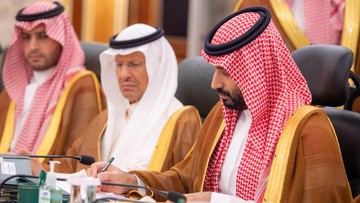
awak Newsroom: For an Indonesian reader, a defense pact in the Middle East is never a distant geopolitical footnote. It touches the price of fuel at the pump, the exchange rate of the rupiah, the shipping insurance premiums on the Malacca Strait, and even the logistics of sending one and a half hundred thousand pilgrims to the holy land. Those are exactly the same variables that suddenly move whenever Ankara, Riyadh, and Islamabad appear to be standing on the same side of a single sheet of paper.
And that is the claim now circulating: Prince Mohammed bin Salman, popularly known as MbS, has openly raised the idea of a defense arrangement involving Saudi Arabia, Turkey, and Pakistan, framed around the protection of the two sacred cities, Mecca and Medina. The reaction online has been fast, and so has the spread of speculation. The problem is that the word pact itself does a lot of heavy lifting.
Secara substansi,(angle) yang rst by
Apa yang Sebenarnya Di Klaim, dan Apa yang Belum Terverifikasi
The single most important distinction in this story is between a binding military treaty and a political statement of intent. A pact, in the language of international relations (the study of how states relate to one another), carries the weight of obligations that can be invoked during a crisis. A joint declaration or a framework agreement is something much softer: a promise of coordination, an exchange of officers, a shared training calendar. Ibarat 소방karena memperpanjang pagar而非 tembok beton baru.
None of the three capitals has, in the circulating accounts, published the full text of any document. That means three things a careful reader should keep in mind. First, there is no way yet to confirm whether the wording actually names Mecca and Medina as the objects of defense, or whether the holy cities are merely symbolic cover for a broader deterrence posture aimed at Tehran. Second, there is no way to know whether any clause survives a change of government. Third, and most practically, a statement made in public does not automatically translate into money, hardware, or mobilization.
The Numbers Behind a Military Balance
To judge whether such a combination could carry real weight, the scale of the partners matters more than the eloquence of the announcement. Saudi Arabia is estimated to spend somewhere between US$70 to 80 billion on defense annually, supported by a security apparatus that has spent a decade buying very expensive systems. Turkey runs one of the largest standing armies in NATO, on the order of 350,000 active personnel, with a budget that in recent years has climbed past US$25 billion as Ankara rapidly expanded its domestic defense industry. Pakistan, with a much smaller treasury and a documented nuclear capability, fields an estimated 600,000-plus active troops and around a hundred and fifty thousand reservists.
Add the populations and the arithmetic starts to look dramatic: roughly 360 million people across the three countries, plus a combined landmass that spans the Arabian Peninsula to the Hindu Kush. Yet population and budget are not the same thing as interoperability, and that gap is where the real difficulty lives.
Teknologi: Tulang Punggung yang Sering Terlupakan
Here is where the story quietly becomes a technology story, and also a cautionary one. Modern deterrence is no longer measured in divisions but in sensing networks, data links, and the speed of a decision loop. The relevant machinery includes air defense systems such as THAAD and China's HQ-9 in Saudi hands, Turkey's S-400 and Bayraktar drone family, and Pakistani deep-strike cruise missiles. Sitting on top of all of it is what military planners call C4ISR: Command, Control, Communications, Computers, Intelligence, Surveillance, and Reconnaissance, or in Indonesian,onter空的 komando, pengendalian, komunikasi, komputer, intelijen, pengintaian, dan pengintaian ulang. Translate it for a general audience and it means the invisible plumbing that lets three armies see the same battlefield picture at the same time.
That plumbing is the hard part. Integrating a US-designed command architecture with Chinese radar, Turkish drones, and Pakistani platforms is not a matter of buying a subscription. It requires shared protocols, common software, joint exercises across years, and officers who trust each other enough to act on incomplete information. Add AI (Artificial Intelligence, atau kecerdasan buatan)-based early-warning tools, which are now central to air defense, and you are describing an integration project measured in a decade, not a news cycle. Riyadh's Vision 2030 and Turkey's defense-export drive point in the same direction, but neither removes the engineering problem.
Implikasi Langsung untuk Indonesia
For Jakarta, the most tangible link is pilgrimage. The 2024 Hajj season saw roughly 1.83 million pilgrims from more than a hundred countries, with Indonesia sending about 144,000, one of the largest quotas in the world. Every change in security posture in the Arabian Peninsula eventually filters into how routes, buses, and hotels are organized in Mina and Arafat. The secondary links are economic: energy prices, and the security environment around chokepoints that Indonesian tankers and cargo vessels pass through.
Diplomatically, any real consolidation among the three would invite a fourth question from Indonesia: what role is left for middle powers that have spent a decade threading a free and active policy through a region of giant alliances. Indonesia's participation in the Organization of Islamic Cooperation, known in English as OIC (Organization of Islamic Cooperation) and in Indonesian as Organisasi Kerja Sama Islam, would give it channels to ask exactly that question, but not automatically a seat at this particular table.
Yang Perlu Ditunggu
The most responsible next step is verification through official channels: the Saudi Press Agency, Turkey's Anadolu Agency, and Pakistan's Press Information Department. Watch the vocabulary. If the documents speak of a partnership, of consultation, or of early warning, this is a reassurance gesture. If they speak of automatic response, of a joint command, of a unified air picture, then the region has entered genuinely new territory. And keep an eye on the neighbors. Any such consolidation would be read immediately in Tehran, Tel Aviv, Cairo, and Abu Dhabi, and those reactions will say more about the real content of the pact than the announcement itself does.








Comments (0)